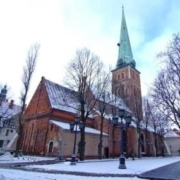
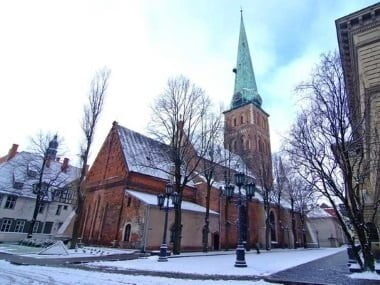
Sights Of Riga

Sights Of Riga

What to see, where to go and where to relax, having arrived in Latvia? One of the most interesting and attractive places for tourists is Riga. The main attractions of Riga are concentrated in the heart of the city – Old Riga, where the streets are still lined with cobblestones and where the medieval color of the city is felt. Outstanding architectural monuments from different eras have been preserved in Riga. The main attraction of Riga is the Old Riga district (‘Old Riga’) with dozens of old buildings.

Botanical Garden

Botanical Garden

Botanical Garden in RigaThe Botanical Garden of the University of Latvia was founded in 1922. On its territory of 15 hectares there are greenhouse and street collections, including approximately 6,000 plants. The Botanical Garden is one of the most favorite holiday destinations in Riga. You can leisurely go around a compact but informative territory, meet representatives of flora from around the world, visit greenhouses of plants, azaleas and tropical butterflies, and just enjoy nature in the midst of urban life. Amateur gardeners who are interested in botany, and those who want to spend time in a beautiful and well-groomed environment and at the same time learn something new – here everyone will find something interesting for themselves.

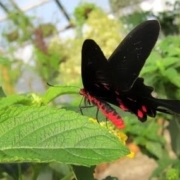
butterfly greenhouse in RigaTropical Butterfly Greenhouse

The botanical garden of the University of Latvia opened the only tropical greenhouse with tropical insects from the tropics of South America, Asia and Africa in the Baltics. In nature, butterflies flutter in flocks on sunny warm lawns. They feed on floral nectar and ripe fruit juice. Now you can also experience tropical exoticism in the greenhouse of tropical butterflies: feel the touch of a fluttering wing, the smell of tropical plants, the stuffiness of the air. No less interesting than the butterflies are their pupae, which can be viewed in different sizes and colors through the glass of the incubator.

Botanical Garden

The collection of the botanical garden is extensive and carefully selected. In the botanical garden you can get acquainted with protected plants, medicinal herbs and toxic plants of Latvia. Most of the trees and shrubs in the arboretum are not typical of the Latvian flora, for example, witch hazel, cedars, lilacs, walnuts, gingko, mulberries, roses, cork trees and edible chestnuts. The garden features a collection of perennials, lilies, dahlias, herbaceous perennials and other ornamental plants. As part of a special exhibition, you can get acquainted with marsh plants, as well as mosses and lichens. In the greenhouses there are various tropical and subtropical, as well as desert plants, including cacti.

Each visitor to the Botanical Garden will be able to choose a plant for home, garden, pond and other purposes from a wide range of presented plants. From the specialists working here, you can get comprehensive information on horticulture and floriculture, as well as plant protection and the features of caring for them. In addition, by prior arrangement, it is possible to take part in seminars covering plant propagation issues, especially their cultivation, information on plant diseases and pests, as well as on their use in everyday life.

In the middle of summer, during the flowering of linden in the botanical garden, a holiday is held gathering gardeners, breeders, and gardeners who like to enjoy the achievements of Latvian gardeners, a variety of garden plants, be inspired by ideas for their garden and feel the summer, enjoying the magic of colors, sounds and smells. During the exhibition, you can buy and sell plants, goods and books on gardening.

A visit to the Botanical Garden is a great opportunity to get acquainted with plants around the world, as well as look at interesting and unusual plants, learn about the features of their cultivation and care for them.

Contacts Botanical Garden:

Address: Kandavas iela 2, Riga, LV-1083
Phone: +371 67450852
E-mail: botaniskais.darzs@lu.lv

Riga Zoo

Riga Zoo

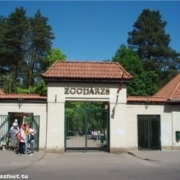
Zoo in RigaThe zoo in Riga is located on the territory of the picturesque Mezhaparks microdistrict, west of Lake Kishezers. The foundation of the Riga Zoo was laid by the Riga Zoological Garden Society, founded around 1908. Already on October 14, 1912, the zoo opened to visitors and presented 267 animals of 88 species. Of the structures of those times, a mountain cafe on the shore of the lake, an entrance gate and an administration building have been preserved to this day. In 1914, the Zoological Garden acquired 538 animals.

During the First World War, many animals were taken to Germany and Koenigsberg, and the zoo closed. It opened on September 24, 1933 thanks to the new society “Latvian Zoological Garden”. The collection of the inhabitants of the zoo was then small – 124 animals of 48 species. The Second World War, which soon began, did not contribute to the development of the zoo. Only thanks to the dedicated work of the employees, the collection of animals and premises was saved almost without loss.

After the Second World War, the Riga Zoo was developing steadily and soon became one of the best in the entire Soviet Union. In 1987, there were 2150 animals of 405 species.

The zoo experienced bad times during the collapse of the Soviet Union: the number of visitors decreased, the crisis began. However, today the zoo is expanding again, active construction is underway, the collection of animals is increasing – the zoo is preparing to celebrate its centenary.

Riga Zoo is a favorite vacation spot of local residents and one of the most visited tourist attractions of Riga. To date, the exposition of the zoo, located on 20 hectares, is represented by more than 430 species of various animals, birds, and other animals. Now visitors to the zoo are offered excursions lasting from 1 hour 30 minutes to three hours.

Riga Zoo is constantly evolving, new buildings and expositions appear, animal collections are being updated. In addition, the Riga Zoo has a Ciruli branch, which is located on the Riga-Liepaja highway. In the zoo Ziruli 38 species of wild animals and 12 species of domestic animals live.

Cathedral of the Nativity

Cathedral of the Nativity

Cathedral in RigaThe need to build a new cathedral in Riga was discussed at the end of the 18th century. But the practical implementation of this idea began to be realized only after a hundred years. With the blessing of the Bishop of Riga and Mitava, Benjamin (Karelin), in the seventies of the 19th century, collection of donations for the future church began. Six months later, Prince Bagration, being the Governor General of the Baltic Region, sent a petition to the Minister of Internal Affairs of Russia to build a worthy cathedral in Riga.

Nature itself “joined” the petition. September 1, 1873 a storm broke out over Riga. One of the lightning strikes fell on Petro – Pavlovsky Cathedral. Collapsed the top cornice of the bell tower. Fire destroyed part of the painting. In many places, gilding disappeared. The windows were left without windows. The cathedral, which was already extremely cramped and modest in decoration, began to require significant repairs.

This fact accelerated the resolution of the issue. On April 17, 1874, at the behest of Alexander II, the Diocese of Riga was allocated 900 thousand rubles.

At this time, three famous Riga architects J.-F. Bauman, G. Schel and R. Pflug have already completed work on their projects for the future cathedral.

Each project took place in Riga, St. Petersburg and Moscow with a competent expert assessment. As a result, in December 1875, on the project of Academician Pflug, the resolution of Alexander II was inscribed: “Proceed to the construction …”

Construction was commissioned on a competitive basis. Preference was given to the Vilnius provincial architect, academician Chagin.

The consecration of the bookmark of the cathedral took place on July 3, 1876. The first stone in the future building was laid by the bishop of Riga and Mitava Seraphim (Protopopov).

By the beginning of the 80s of the XIX century, the construction of the building was almost completed. But at this time, Alexander III sent 12 bells to the temple as a gift. The largest, in the name of Alexander Nevsky, weighed more than 800 pounds. Each bell was an outstanding work of art casting. They were cast at the factory of the Moscow merchant Nikolai Dmitrievich Finland. The bell was cast by one of the outstanding masters of the late 19th century Xenophon Verevkin.

This ensemble of bells required a special architectural solution for their placement. R. Pflug was commissioned with additional design. The architect’s project was very successful. The bell tower above the main entrance to the temple created a special perspective. Performed in a single architectural style with the cathedral, it gave great volume to a very tall building as a whole.

Eight years later, the construction of the temple was completely completed. April 24, 1884 he was transferred to the jurisdiction of the spiritual department. And on Saturday, October 27, 1884, the first ringing of all 12 bells of the Cathedral of the Nativity of Christ the Savior was heard over Riga for the first time.

Soon the Riga Cathedral became the universally recognized spiritual center of not only Riga, but the whole region. Many prominent representatives of the clergy take part in its activity. In a number of sources, information has been preserved that in September 1894, Archpriest John of Kronstadt, who was now considered a saint, performed the service here.

At the head of the multilateral activities of the cathedral were its abbots. The first of them is Archpriest V. S. Knyazev. Professor of church-biblical history, canon law and church archeology, he contributed in every way to enriching the spiritual, moral and aesthetic level of the church’s activity, wider involvement of Orthodox Riga residents in the history of culture, and original traditions.

In the first decade of the 20th century, Archpriest V. I. Plis, teacher of the Riga Theological Seminary, is appointed the rector of the cathedral. Thanks to outstanding representatives of the clergy and highly educated residents of Riga, the prestige of the cathedral was exceptionally high, especially since the services were performed here in four languages: Church Slavonic, Latvian, Estonian and German.

According to contemporaries, every visit to the cathedral brought people peace of mind, the joy of a highly spiritual state. To a large extent this was facilitated by the special inner atmosphere of the temple, its decoration, the general harmony of everything around.

Carved iconostases and choirs had a single artistic solution. They were decorated with patterned columns, a gilded ornament of cast zinc, and unique wood carvings. Of particular artistic value were openwork gilded gates of the main aisle. Church utensils fit into the general style of the cathedral. All her items were made of silver of the 84th test by skilled craftsmen of the Moscow manufacturer Khlebnikov.

For several years the sacristy of the cathedral was created. The vestments of the clergy sewed the best gold seamstresses of the brocade workshop of the St. Petersburg merchant Zheverzheev. Unfortunately, the authors and performers of these unique products have remained unknown.

A truly priceless treasure of the Cathedral of the Nativity of Christ the Savior was his collection of icons. They were performed on canvas and zinc, white metal and cypress wood. They were written on a golden background, focusing on samples of ancient church painting. Many people donated icons to the cathedral and personally participated in the enrichment of this outstanding collection of icon paintings, some of which have been preserved since the founding of the Diocese of Riga (1850).

The icons of the earliest writing included those that were transferred by a procession from the Peter and Paul Cathedral on the day of the consecration of the new cathedral. A significant part of the icons was commissioned by the construction committee. Outstanding artists became their authors. Brushes of V.V. Vereshchagin belonged to the church icons “Nativity of Christ”, “Nativity of the Blessed Virgin Mary” and “St. Alexander Nevskiy”. He was also the author of the icons of the first tier of the main iconostasis and the Royal Doors.

The icons of the second and third tiers of the main iconostasis were painted by the artist Vasiliev. Among the works of K. Shamshin, the icons “The Virgin and Child” and “John the Baptist” are known.

Among the donors of the icons were not only Riga residents, but also residents of many other places, in particular St. Petersburg and Moscow.

It is known that in the main and additional church and sacristy inventories 850 items were listed. All of them had church, historical, artistic and material value. These included church painting, liturgical books, vestments, miter, carpets, and much, much more. A significant part of these unique values ​​was donated by Riga residents. There were so many Riga benefactors that it was not possible to name all of them. Gifts came from Riga merchants, high society circles, and various societies.

In general, more than half a million rubles were spent on the construction of the cathedral. The internal arrangement cost 140,212 rubles 87 kopecks. This at a time when a pound (400 g) of bread was worth 2 kopecks, and meat – 15, a thousand times cheaper than now, silver.

The tragic turn in the fate of the temple began in the First World War. In 1918, the Riga Municipality actually closed the cathedral. Worship in it was forbidden. And when Archbishop John Pommer arrived in Latvia at the invitation of the All-Latvian Council of Orthodox Parishes, he found the church in disastrous condition.

Windows without glass. The bell tower without its unique bells. The decoration is defiled. Dear, artwork, the iconostases are warped, piled in a heap. Damaged painting, crucifix thrown into the trash. Everything that was valuable disappeared. To this day, they still argue about who is to blame and where the most valuable monuments of Orthodox church art and centuries-old culture have gone. There are many versions, but little has been returned.

The difficult path to resurrection began with the fact that His Eminence Archbishop John (Pommer), in order to prevent the further destruction of the church, to collect everything that remained and could be put in order, restored, settled in the basement of the cathedral. The stove was folded for heating. Gradually, at the cost of considerable efforts and hard struggle, the restoration of the temple began. The residents of Riga helped those Russians who suddenly became emigrants, lost everything, lost their roof over their heads.

The activity of the cathedral was resumed with difficulty. At first, a special permission of the authorities was required for each service. And only from Christmas 1922 the cathedral began its daily service. The service was performed in Church Slavonic and Latvian languages.

By the mid-30s, the cathedral was put in order, the painting was updated. There was a stubborn struggle for the return of the former property of the cathedral, including icons, church utensils. The temple again became the spiritual center of Riga.

A new blow was dealt by the Second World War. Again the ruin and resurrection of the cathedral again. After the war, ordinary spiritual life went on. The Cathedral continued to be a spiritual pillar for many, many people who knew the horrors and troubles of this monstrous war.

But the fact that the two world wars and the revolution did not destroy was ruined in the 60s. By order of the Council of Ministers on October 5, 1963, the cathedral was closed. This time everything was destroyed and taken away. From the cathedral there were only walls. But they are also mutilated, they are covered with reinforced concrete, and floors are made. Build and remodel the internal space, destroying the painting. Dealers from “knowledge” turn the temple into a profitable place and have been exploiting it for thirty years.

Only in July 1991 did the difficult path to resurrection begin. Almost five years was dismantling. The difficulty was that the ceiling, unknown as laid, posed a threat to the walls of the building itself. Not only significant funds were required, but also extreme caution. Of particular difficulty was the restoration of the central dome.

The spiritual life of the cathedral began in difficult conditions on January 6, 1992, when His Eminence Vladyka Alexander performed the first service. Since then, regular worship services have begun. At the same time, with incredible difficulties, but continuously, day after day, restoration work was carried out. Every step in this direction from year to year is given with great difficulty. Now the Cathedral is beautifully painted. All domes are covered with copper, a new roof is made. Gilded cross on the central dome. But much remains to be done.

Families of benefactors Vladimir Ivanovich Malyshkov and Igor Vladimirovich Malyshkov donated a beautiful iconostasis.

Through the efforts of many, many people, the triple-risen “Riga”, as it is popularly called, the Nativity of Christ Cathedral, has already found its rightful place in the spiritual and cultural life of Latvia.

Information taken from the official website of the Riga Cathedral – http://sobor.lv/

Ethnographical museum

Ethnographical museum

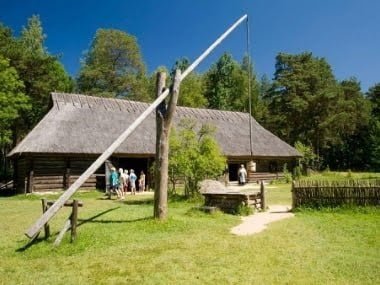
Ethnographic Museum In RigaEthnographical museum in Riga was founded in 1924, and since then 118 old buildings have been moved here from all over Latvia – Kurzeme, Vidzeme, Zemgale and Latgale. All of them are located in the museum so as to create an idea of ​​the historical rural landscape of Latvia. The museum presents the buildings of peasants, artisans and fishermen, as well as farm buildings – a tavern, forges, mills, churches. The interior and furnishings of buildings correspond to specific regions of Latvia and the lifestyle of people living in them.

Ethnographic open-air museum in Riga will give a thorough idea of ​​what Latvia looked like in those almost epic times when the peasant was still a universal breadwinner. The museum on the shores of Lake Jugla is an amazing place for long leisurely walks. You can take your picnic basket with you, or you can pay tribute to the Latvian cuisine in a real roadside inn under the pine trees.

The Ethnographic Museum occupies 87 hectares of well-groomed forest park. For display to the public from all four cultural and historical regions of Latvia – Kurzeme, Zemgale, Vidzeme and Latgale – 118 authentic old Latvian buildings were brought here and reassembled. Peasant farmsteads, windmills, forges, pottery furnaces and tarry shops, craftsman’s workshops, characteristic of their locality, in some of which you can observe the work of masters of primordial crafts.

Every year, at the end of the first week of June, an extensive fair is held at the Ethnographic Museum, where Latvian artisans and artists bring high-quality jewelry, textiles, woven and forged products, ceramics, etc.

Working time Ethnographical museum:

MUSEUM OPEN DAILY FROM 10.00 TO 17.00

Address Ethnographical museum:

Brivibas Street 10, Riga, LV-1024

St. James Cathedral

St. James Cathedral

Cathedral of St. JacobSt. Jacob’s Cathedral in Riga is the main Catholic church in Latvia, the fourth largest church in Riga. The cathedral. St. James is a brick gothic monument. The first mention of the church, located on the site of the present cathedral, dates from 1225. This date, engraved on the central western facade of the church, is considered the presumptive year of the construction of the Church of St. James.
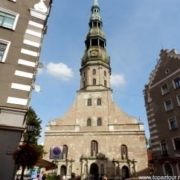
During the reformation in 1552, parishioners risked holding the first Lutheran service in Riga’s history in this church. In 1524, during the peak of anti-Catholic unrest, St. Jacob’s Church, like most of the Catholic churches of the city, was defeated, which resulted in the almost complete destruction of the interior.

During the siege of the city by Russian troops of Tsar Alexei Mikhailovich several shells fall into the church of St. James. Two of them in memory of the siege of Riga were walled up in the walls of the central facade, and two more – in the altar.

Throughout its history, the church changed its religion several times and was partially rebuilt. In 1756, an octagonal-shaped pointed spire was added to the main church building. In 1782, a new central portal was built. Since 1923, the Church of St. James once again belongs to the Catholic religion.

The height of the church tower, including the spire, is 80 meters. In the interior, you can see a floral ornament adorning the capitals in the choirs of the church. This type of ornament is rare for the church canon of Gothic sculptural decoration. Initially, the church was of the hall type, today it is a three-nave structure, comprising in plan 27 by 50 meters. In general, the interior of the church is quite simple and concise, which, however, corresponds to the concept of designing Catholic sacred structures. In 1736, a traditional weather vane in the form of a rooster was placed on the spire of the church tower, which we can see today.

In 1680, an altar was created in the church, which at that time was the main royal Lutheran church. It is assumed that it is the earliest baroque altar in Latvia. Who is the creator of this altar is unknown. In 1902, a decision was made to eliminate the altar, which had already fallen into disrepair. 2 craftsmen were invited to build the new one: woodcarver Jacob Schrade and sculptor Christoph Mittelhausen. Despite the fact that the old altar was dismantled, something remained of it, namely the carved figure of the angels adorning it, which are stored in the Museum of the History of Riga and Navigation. In 1924, a new altar appeared, which was already the third in a row.

One of the interesting elements of the interior of the church of St. James is the department. It is made in the Empire style, it was made by the master August Gothilf Heybel in 1810. The department was made of red wood, intarsions with rich floral ornaments and exquisite arabesques were placed on its area. In general, the peculiarity of the temple is a mixture of architectural styles in the interior of the church, while on the outside it is relatively homogeneous.

In 1761, organ master Heinrich Andrei Konzius set about creating an organ for the church. To this day, this body has not been preserved. The new one was made in 1913, the master E. Martin became the creator of the modern organ. The windows of the Cathedral of St. James are covered with stained-glass windows, the creation of which dates back to the last century. So, three bright stained glass windows that adorn the windows of the eastern wall of the choir were made in 1902 in the Art Nouveau style.

St. Peter’s Church

St. Peter’s Church

St. Peter's Church in RigaSt. Peter’s Church in Riga is a unique symbol and one of the main attractions of the city of Riga (Latvia). This outstanding piece of architecture was first mentioned in 1209. The church is known for its unusual spire, whose height is 64.5 meters with a total height of the church tower of 123.5 meters.

St. Peter’s Church was erected as a folk church. He, contrary to the Dome Cathedral, which was built by the Riga authorities, was erected on the collected funds from artisans, merchants, and even ordinary peasants. At the same time, St. Peter’s Church was the main cult building of a privileged segment of the population in feudal Riga. One of the oldest schools of the city worked at the temple.

The temple was built in the Gothic style. Initially, the room was not very large. It was planned to build an ordinary church. But at the beginning of the 15th century a new altar part of the building and a bell tower in the Gothic style were erected. After, in the 17th century, decorated baroque portals were erected, and a spire appeared at the church, which we can observe today.

The spire of St. Peter’s Church is the most recognizable part of it and an inseparable component of the panorama of the city of Riga.

In the 13th century, the temple tower may have been a stand-alone building. For the first time, as part of the church, the tower was built at the end of the 15th century. It was then that an octagonal spire of wood was erected, which stood for almost two hundred years. In the middle of the XVII century, the aged spire collapsed. One of the houses was damaged, and eight people were killed. The spire was restored the following year, but after 10 years it burned down. In 1690, the spire was rebuilt. It is interesting that for a long time this spire was the highest wooden spire in Europe, whose height is 64.5 meters with a total height of the church tower of 123.5 meters.

In 1721 lightning hit the tower of St. Peter’s Church. There was a fire. The Russian emperor Peter I, who was in Riga at that time, took part in its suppression. Unfortunately, the fire could not be put out. The spire almost completely burned out and collapsed. Fortunately, the burning spire did not fall upon the city, but “took shape in itself.” This did not cause unnecessary damage. According to legend, the prayers of Peter I helped. In the same year, Peter I ordered to recreate the spire by his decree. The work was completed only after two dozen years – in 1741. The reconstructed spire lasted exactly two centuries and was destroyed on St. Peter’s Day (according to the Gregorian calendar). The church was badly damaged during the Second World War. For a long time the building was destroyed. And only in 1966 it was restored. The construction of the spire was completed only in 1973. The shapes and sizes of the new spire completely repeated the original. But it was made of metal. In the spire appeared two viewing platforms at a height of 57 and 71 meters. And for the convenience of visitors, an elevator and reinforced concrete stairs were installed.

Today, viewing platforms of St. Peter’s Church are especially popular among tourists and visitors of the city, and the spire itself is depicted in many pictures and souvenirs.

Church of Our Lady of Sorrows

Church of Our Lady of Sorrows

The Basilica Of Our Lady Of SorrowsThe Church of Our Lady of Sorrows in Riga is the first stone sacred building in Riga, built after the start of the Reformation in Livonia. In its place stood a small chapel, consecrated in 1865. In 1875, the Austrian Emperor Joseph II passed through Riga, who, visiting this small church, was extremely surprised and indignant at the poor and unsightly appearance of the chapel. He donated an impressive amount of money to build a more representative temple.
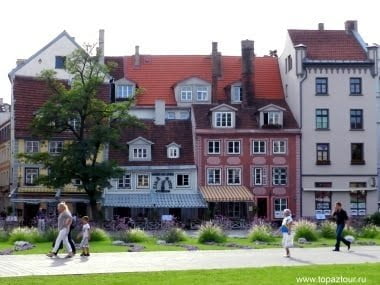
The first stone in the foundation of the future church was consecrated in 1784, and a year later the newly built church was consecrated in honor of Our Lady of Sorrows, the service was carried out by Bishop Janis Benislavskis. The future emperor of Russia Paul I, the Polish king Stanislav Ponyatovsky and other Polish magnates donated to the construction of the church. In addition, local Catholics provided financial assistance, as far as possible. According to the instructions of Empress Catherine II, all the buildings on the castle square, including the church, were to be built in the style of classicism.

The church had three entrances, the main one was located on the side. The church itself was made in the style of classicism, but some details belonged to the baroque.

In May 1854, the Russian Emperor Nicholas I came to Riga, who, after inspecting the temple, said that the building was not spacious enough, namely too narrow. The emperor’s remarks accelerated the repair work. In 1858, a radical restoration of the building began, which lasted 2 years. The head of perestroika was the young and talented architect Johann Daniel Felsko.

The last rebuilding of the Church of Our Lady of Sorrows, as a result of which the church acquired a modern appearance, took place in 1895. The architect of the project was the German master Wilhelm Boxlough. He gave the building a neo-Renaissance look and expanded it by completing the premises for the baptismal ceremony.

As a result, the Church of Our Lady of Sorrows acquired a graceful, eclectic finish, which has survived to the present day with almost no changes. The height of the church, including the steeple, is 35 meters. The main entrance is located on the side of Castle Square. The church is 48 meters long and 17 meters wide. The Church of Our Lady of Sorrows refers to church buildings of the hall type. The top of the three-story tower, which serves as the dominant, is crowned with a pyramidal spire.

Regarding the interior, it is worth noting that after repeated reorganizations, each of which brought something of its own, that there was a bizarre mixture of all architectural styles in it. Here you can see the elements of classicism, in this style the church was made initially. The first perestroika brought elements of romance and Gothic, well, later neo-Renaissance elements also appeared. The church safely endured the periods of wars and Soviet times, all this time it was active.

Livu Square

Līvu SquareThe picturesque Livu Square appeared in Riga in 1950 on the site of a building destroyed during the Great Patriotic War. Designed by P. Seletsky.
Officially, the square was called the square at the Philharmonic. In 1974, it was reconstructed on the idea of ​​K. Barons. A network of paths was laid out and recreational facilities equipped. In the center of the square there was a pool with a fountain, which is currently not working. In February 2000, the square at the Philharmonic was renamed by the Riga authorities in Livu Square.

In winter, Livu Square turns into a city skating rink, and in summer – into a wonderful cafe where you can buy various souvenirs. All kinds of events are often held here in the summer. The area has developed on 0.5 hectares.

If you go from the Freedom monument through the City Canal to Livsky Square, you can see the most beautiful buildings of the Big and Small Guilds, located opposite each other on Amatu Street. In 1354, German merchants, who owned all trade in Riga, organized the Great Guild. Her activities were liquidated after the 1917 revolution. The building of the Great Guild acquired a modern look in the middle of the 19th century. In 1965 it was reconstructed and adapted for the work of the Latvian State Philharmonic. In the lobby of the Philharmonic you can see stained-glass windows, made according to the sketches of the Latvian artist A. Tsirulis. The building of the Great Guild has majestic eclectic forms of English Gothic.

The building of the Small Guild is built in the same style. The small guild was formed in the 13th century and was an association of all artisans. Only its members had the opportunity to become guild masters. In 1936 it was eliminated.

Opposite the Great Guild there is a grandiose building with two towers, each of which has black cats. This is the famous Black Cat House or Cat House, which is an unofficial visiting card of Riga. The building in the style of late rational Art Nouveau was built in 1909 by the architect Friedrich Scheffel.

There is an ancient legend according to which the wealthy homeowner Blumer did not get into the Riga Big Guild and, of course, was very angry. He commissioned sculptural images of black cats with arched backs. They were placed on the peaked turrets of the Blumer apartment building. But the most interesting thing is that these cats were turned tails towards the windows of the working room of the elder of the Big Guild, clearly showing the cynical attitude of the merchant to the members of the guild.

According to one of the branches of this traditional excursion bike, a trial was organized against Blumer. They say that he was never able to get the cats to turn in the right direction. Most likely, Blumer was a close friend of the judge or paid generous bribes to frequently changing judges, who in the sentence stated that cats are free animals and they walk on their own, and most importantly, without them, Riga will lose some of its architectural wealth. It is difficult to say when it was possible to agree with Mr. Blumer, however, at one fine moment the cats were deployed with the “right” angle.

Livu Square, the Big and Small Guilds and the Cat House in Riga are a harmonious architectural ensemble, attracting with its grandeur and beauty.

Swedish gate

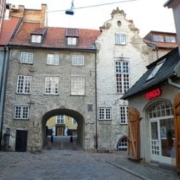
Swedish gateSwedish gate

The Swedish Gate is a cultural monument, an architectural complex located in several houses on Tornja Street in Riga in Latvia.

In 1621, Riga was ruled by Sweden. The Swedish occupation continued until 1711. Naturally, Swedish rule left a noticeable mark on Riga history. At this time, new architecture buildings appeared in the city: the Yakovlev barracks or the Jekaba barracks and the Swedish Gate, which are currently among the most popular attractions in Riga.

Peter I ordered the destruction of the Jekaba barracks. Later, new ones were built in their place. The Swedish gate is the only one of all the city gates that have survived to our days almost unchanged.

The legend tells that the Swedish gate was erected at the end of the XVII century. One initiative and enterprising Riga merchant decided to cut through the gate in his house number 11 on Tornia street. In this way, he wanted to evade paying duties on goods that were officially imported through the Sand City Gate. Since the gates were located in his house, the merchant decided to charge a fare through them.

However, there is a more realistic version of the formation of the Swedish Gate. Most likely, the city authorities decided to equip a lockable passage to the buildings located on Tornia Street. Therefore, new gates were cut through.

The Swedish gate was so called for two reasons: first of all, their appearance coincided with the time of the occupation of Riga by the Swedes, and the second reason is that most often the Swedish soldiers used this gate. The soldiers were housed in the Yakovlevsky barracks, which were located near the gate. Therefore, the Swedish gate is a kind of symbol of the era of the Swedes. At night, the Swedish gates were locked on powerful deadbolts, and the watchman kept a close watch so that not a single living soul could penetrate through them.

There is a legend that speaks of the height of a terrible plague. At this time, the city was in quarantine. One young girl tried to get through the Swedish gate to see her lover. But the guards managed to catch her. The girl was treated very cruelly. She was walled up alive in the wall. Since then, at night from the side of the wall, terrible cries and groans of the unfortunate have been heard.

But not only this unfortunate girl became a hostage of the Swedish gate. According to another legend, two lovers were walled up in a wall near the gate: a Latvian girl and a Swedish officer. Their love was initially doomed. Indeed, according to the laws of Sweden, officers could only marry Swedish girls. The lovers neglected the rules, for which they paid with their own lives.

Nowadays, this ancient legend allows lovers to check the sincerity of their feelings. You need to go through the Swedish gate with your soulmate. And if their feelings are as strong as the feelings of unfortunate lovers, then exactly at midnight the couple will hear the treasured “I love you!” Coming from the wall.

They also say that for some time a city executioner lived in an apartment located above the Swedish gate. He had a habit of “warning” Riga residents about the impending execution. The night before, he always laid a red rose on the window, and all the inhabitants knew about the impending bloody action.

In 1926, the Society of Architects of Latvia rented a house with the Swedish Gate from the city authorities, which was rebuilt in accordance with its new purpose. The building acquired a baroque look, completely coinciding with the time of its appearance. The interior of the house (stoves from the tiles of the 17th-18th centuries, classic and Baroque shades and so on) was arranged by the Riga architect and artist A. I. Trofimov.

Currently, the ensemble of the House of Architects includes houses No. 11, No. 13 and No. 15 at the Swedish Gate. In addition to the Latvian Union of Architects, a library is located here, where you can freely access and enrich your knowledge of the history and culture of the country.

Three brothers

The architectural complex of the three brothersArchitectural complex Three brothers.

Three brothers – the oldest residential complex located in Old Riga on Maza Pils Street (Malaya Zamkovaya). These three houses have been preserved since the 15th century. Today they house the Museum of Architecture and the State Center for the Protection of Cultural Monuments.

According to legend, three houses, closely clinging to each other, were really built by men of the same genus. In the Middle Ages, the street on which the houses stood was on the outskirts of the city. Artisans lived here. In the house number 17, the oldest of the “brothers”, there was a craft workshop. It is assumed that the building of the “oldest brother” was built in 1490. The house has an ascetic architecture, the only decoration of the structure are 2 stone columns located in front of the entrance. In this house there was only 1 room, which was used both as a workshop and as a shop, as well as a place where people live. Still preserved stone benches located on both sides of the door of the building, which are characteristic features of the early Middle Ages.

House number 19, which is the middle “brother”, is the most luxurious building, in terms of architecture, among the three brothers. The entrance of the middle “brother” is adorned with the inscription “Soli deo gloria!”. Unlike the eldest “brother”, this house had a separate spacious hall with large windows, while the living quarters were on the courtyard side.

The youngest “brother” was built in the second half of the 17th century. In this house, on each floor there were small apartments. The facade of the building is decorated with a mask. Which, according to the author, was supposed to serve as a defense of the house from evil spirits.

Between 1955 and 1957 restoration of the “three brothers” was carried out. The work was carried out according to the project of Peteris Saulitis, with the help of G. Janson. A stone portal, taken from the lost House of the Blackheads, as well as a forged coat of arms, dated 1554, was walled into the walls.