

 Vidzeme will be remembered by you for its small towns, romantic parks, relief landscapes, sandy cliffs and beautiful rivers. The most beautiful views of Vidzeme are found in the Gauja National Park, especially in the vicinity of Ligatne. The Līgatne nature trail passes through the open-air zoo. The main sights of Vidzeme are powerful medieval castles. The legacy of the 19th century is, first of all, the numerous estates of the Ostseian barons. The secret bunker, which was built in Soviet times in the event of a nuclear war in the basements of the Ligatne Rehabilitation Center, also leaves an unusual impression.
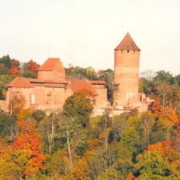

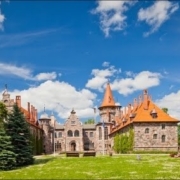
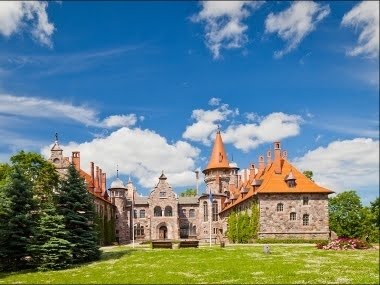
Cesvaine Castle was first mentioned in the 13th century, but it was a wooden Latgal castle on the left bank of the Sula River.
The archbishop’s castle was probably built at the end of the 14th century, as the settlement by the castle is mentioned in the annals in 1410. Cesvaine Castle itself was first mentioned in 1461. In 1479, the castle occupied the order for many years.
The Rusov’s chronicle states that during the Livonian War, in 1577, the castle of Cesvaine was occupied by the Russian troops of Ivan the Terrible. The inhabitants of the castle were captured, but no special damage was inflicted on the structure. The castle was inhabited until the middle of the 17th century. It is likely that Cesvaine castle was destroyed during the Russian-Swedish war. During the construction of the buildings, the ruins of the old castle were almost removed, and in its place the Cesvaine castle was built in the eclectic style, built of granite boulders according to the project of architects G. Grisebach and A. Dinklag. Near the castle, the buildings of the former estate and a romantic park are preserved – there are about 70 species of trees and shrubs.
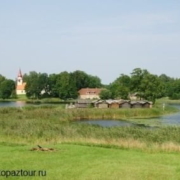
Cesvaine Castle was built on the right bank of the Sula River. From the north and west it was guarded by a river valley about 50 meters wide and more than 10 meters deep. The river itself is shallow, about 3 meters wide. On the east side was a mill pond. On the south side was a bastion, which was surrounded by a moat, traces of which have survived to this day.
The main castle in the plan was a square. To the south was a bastion of the same square shape. In the southwestern corner of the bastion was a semicircular tower, in which there was an entrance. Later, the entry was moved to the south wall. After the appearance of firearms, in the XVI century, earthen ramparts were poured in the northern corners of the bastion.
Now only the foundation of the western wall is preserved from the old castle, about 50 meters long and about 1 meter high. The width of the base of the wall was 1.5 meters. At the southern end of the wall, the ruins of a 1-2-meter-high southwestern semicircular tower were also preserved.
Tourists, accompanied by a guide, can explore the premises of the castle, and climb the 30-meter observation tower, from which they can see the surroundings within a radius of 20 km.

 Kropotkin Palace.
In the XVII century, a landowner estate began to form on the territory of Sigulda Castle. Several buildings have survived here, erected in the XVIII and XIX centuries during the time of the owners of von der Borchov and Kropotkin – Summer Castle, New Castle, White Castle, Burmistra’s House, manor houses, barn, laundry, cellars for root crops and vegetables.
The new palace (Kropotkin Palace) in Sigulda was built by Princess Olga Kropotkina, nee Countess von der Borch, in 1878 – 1882 on the site of the Order Castle. The Kropotkin Palace was built in the style of the Tudov neo-Gothic style from large, crafted, boulders. The work was supervised by a master mason Janis Mengelis.
Visiting the Kropotkin, who spent the summer months in this palace, many high-ranking guests from the capital visited.
During the First World War, the building was destroyed.
In 1921, the restored Kropotkin Palace passed into the possession of the state. In 1923, the Society of Journalists was housed in the palace. In 1930, the windows of the palace were installed stained glass M. Strunke “Four Seasons”. The building was installed picturesque work of K. Skuin.
In 1936-1937, in the palace – the House of Creativity or the Palace of the Press – perestroika was carried out. According to the project of architect A. Birkans, the height of the tower was increased. The interior authors are well-known Latvian artists of Latvia: Vilis Vasarinsh, Niklavs Strunke, Peteris Ozolins, Karlis Sunins.
During the Second World War, the Kropotkin Palace was used for the needs of the headquarters of the Nord German army. After the war, the USSR Council of Ministers placed a rest house for senior officials in the palace.
In 1953, the palace housed the Sigulda Cardiological and Climatic Sanatorium.
After the restoration of Latvia’s independence in 1991, the Kropotkin Palace was ceded to the state and since 2003 the Sigulda Duma, a restaurant has been located here.
Next to the New Castle is the so-called Yellow House (aka Summer Castle). It was built in the style of classicism at the turn of the 18th-19th centuries. A wooden longitudinal building was erected under the guidance of a master from the city of Cesis, called the last livin of Vidzeme, Marcis Sarums. Here the Kropotkins lived until the completion of the construction of the New Palace. There is also a small church where services were held for the owners of the estate.
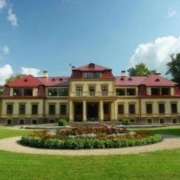

 Līgatne – the nature trails of the Gauja National Park were created in 1975 with the aim of acquainting visitors with nature, the species of wild mammals living in Latvia, the diversity of nature and the need for protection.
On the banks of the Gauja River, in a region rich in wooded ravines, trails have been laid for more than 5 km where you can observe animals and birds characteristic of the Latvian fauna. A visit takes an average of 2-2.5 hours.
Wild animals found on nature trails in Ligatne were brought from various places in Latvia. These were injured or tamed cubs of animals that could not survive without human care and constantly find food. Roofs, wild boars, bears, foxes, wolves, moose, lynxes, owls, eagle owls and bison can be observed along the fences of the Ligatne nature trails.
Visiting nature trails in Ligatne, visitors are advised to wear comfortable clothing and shoes suitable for hiking.
Ligatne and its environs contain a significant amount of sandstone outcrops, which we call rocks and rocks. Perhaps there is the largest concentration of sandstone rocks in Latvia, which the inhabitants of Ligatne and its environs have used for many years for domestic and industrial purposes, creating cave and cellar systems.
In Ligatne and its environs there are several tens of rocks and rocks, and the value of all these pearls of nature is no less significant, because how not to mention the Gudu rocks, the Kuku rocks, the Zvarte breed and others.
Very interesting discoveries are associated with caves and cellars located in the rocks. And immediately it is worth recalling that this is not a scourge of the Soviet era, the tradition of using the advantages given by nature in Ligatne has a more ancient history.
Here is what Aivar Balodis, a researcher in the history of Ligatne, writes about this:
“Every self-respecting person thinks that with Ligatne cellars everything is more than clear. Here we are talking about cellars carved in sandstone rocks. Pink, golden and gray sandstone rocks formed 350-370 million years ago. They formed when the currents demolished sand particles and clay rocks that settled, compacted, and cemented to form sandstone and dolomite or sedimentary rocks visible today. ”
Visiting the caves and cellars of Ligatne is available to tourists only with a guide!
On the territory of the Ligatne rehabilitation center at a depth of 9m underground there is a well-equipped bunker with an area of 2000 m2, the stigma of which was removed only in 2003. The bunker was built in the 80s of the last century for the needs of the political and state elite in the event of a nuclear war. Secret shelter of the first secretaries of the Soviet Communist Party, the bunker was one of the strategically important places in Soviet Latvia in the event of a nuclear war. The most powerful autonomous economic structure with all the necessary and latest equipment of the time. Until now, we managed to preserve all the authentic underground equipment!


 cst
cst
