 Basilica in Aglona. In the east of Latvia, in the Preili region, the small town of Aglona is located. It is located in a very beautiful area, between two picturesque lakes. There are many legends associated with this town. So locals believe that it was in this town in the 13th century that the famous Lithuanian King Mindaugas was killed and buried (Lithuanians have a different opinion). This town is populated mainly by Latgale people – very welcoming and open people, having their own respectable culture and traditions.
In the XV century, the Icon of the Virgin Mary was delivered from Lithuania to Aglona. Prior to that, she was in the city of Trakai, the former ancient capital of Lithuania. But this Icon came to Lithuania from Byzantium, as a gift from one of the Byzantine Emperors to the Great Prince of Lithuania Vytautas the Great. That is, the Aglona Icon, like the Ostrobramskoy Mother of God of Vilnius and the Polish Czestochowic Mother of God, was originally Orthodox. And in our time, the Aglona Icon is equally revered by Catholics, Orthodox and Old Believers. The icon was placed in a local wooden church, in which it stayed for almost three centuries.
In the sixteenth century, the appearance of the Mother of God to a local resident took place on a hill near the church. Mother of God predicted the prosperity of this place and the fact that so many people would come here. Nowadays, both pilgrims arriving on August 15 and ordinary residents of Aglona come to the place of occurrence. They pray at the statue of the Virgin Mary installed on this place, asking them to bless them for good deeds.
In the second half of the eighteenth century in the eastern part of Latvia (Latgale) began the period known as the “Latgale Baroque” period. Local nobles actively donated for the construction of beautiful large churches, with the condition that they were “no worse than European.” So at this time in Daugavpils there was a church of St. Peter, which is no less than a small copy of the famous St. Peter’s Basilica in the Vatican. In Kraslava, the church of St. Louis, which became a smaller copy of the main church of the Jesuit Order of the Church of Del Gesu in Rome. At the same time, in 1780, a new majestic stone church was built in Aglona.
The basilica in Aglone is simply amazing in its beauty. Against the backdrop of a beautiful rural landscape, a dazzling white two-tower church rises. Inside the temple is decorated in a very beautiful style inherent in the Baroque period. It is divided into three parts and all three parts are accessible to believers. At the top of the temple is the Aglona Icon of the Mother of God herself, to which every believer can come at any time. Near the Icon is located, so to speak, a foyer in which the photo exhibition “Temples of Latgale” has been exhibited for more than one year. This exhibition captures both Catholic churches, Orthodox churches, Old Believers’ prayers and Lutheran churches.
On the ground floor there is the main temple, where daily masses are held, and naturally, festive services. It also has many other shrines for Catholics, for example, there is an icon of the Mother of God of the Rosary. Also, recently in the main temple on the ground floor there is a round-the-clock adoration. Adoration is the constant worship of the Savior. The Savior in this case, in the Catholic tradition, is symbolized by the sacrament of St. Communion enclosed in a beautiful frame.
In the lower floor, the crypt of the temple, burial places are located. So there lies one of the outstanding Catholic clergymen of Latvia – the first Latvian Cardinal Julian Vaivod, as well as two outstanding Catholic priests of the Latgale region – Boleslav Sloscans and Jazep Rantsans.
In front of the entrance to the Basilica, a special canopy and a balcony were built on which celebratory services are held on August 13-15.
The Basilica is surrounded by Sacral Square, on which Religious Passages take place on August 14, and also faithful pilgrims from all over Latvia and many countries of the world who come for the holidays on August 13-15. In the 90s of the last century, Sacred Square was restored and decorated. The late Riga sculptor Igor Vasiliev, as well as sculptors and restorers from Armenia, worked in her decoration.
Not far from the Basilica is a source of holy water. This source in the nineteenth century was studied by scientists from St. Petersburg, and found this water to be healing. So that it is useful even for non-Catholics.
What is noteworthy, the Mother of God really kept and preserves this Basilica and this land throughout the centuries-old history. So the Basilica in Aglona did not suffer in any of the many wars that passed through this region. And during the Great Patriotic War, this temple was saved just miraculously. It happened on July 29, 1944. At this time, the Nazis were already running away from the Latgale region. And, running away, they destroyed everything in their path. Among other things, they decided to blow up the Aglona Church. So they sent a team of bombers there, which with German pedantry and professionalism laid the explosives. They laid the explosives, including on the top floor in the altar near the Icon of the Mother of God. And then something inexplicable happened. Hitler’s bombers suddenly died out of a dream, and they fell asleep right in the church, naturally without activating the explosives. And they slept so soundly that only our advanced units, who took them prisoner, woke them, thereby the church saved the church. Believing Catholics, on the other hand, believe that the Nazis themselves were put to sleep by the Mother of God, who defended her shrine. The Aglona church survived in Latvia in the Khrushchev era, when the Orthodox churches and Catholic churches equally got to it.
In 1980, in honor of the 200th anniversary of the construction of the church and in respect for everything that his parish did, Pope John Paul II granted the church the title of Basilica.
Since August 1991, the penitential Religious Procession around the Basilica has entered the festive tradition in Aglona, where believers recall 15 stops on the Savior’s Way of the Cross and read the prayer of the Rosary (Our Father, the Catholic version of the Virgin Mary, plus the appeal to the Virgin Mary (Blessed Virgin, pray God for we are now at the time of our death) and pray about issues that are relevant for the republic and the world. The participants in the move come with candles, it happens in the evening and looks very beautiful.
In September 1993, during the course of his visit to Latvia, the late Pope John Paul II, who celebrated Mass there, also visited Aglona. After this, the Basilica in Aglona became a place of pilgrimage of international importance, which is today.

 Sights of latgale. Latgale (Latgale) – the spiritual center of Latvian Catholics. Many crucifixes along the roads testify to the deep devotion to the faith of the inhabitants of these places. The Latgale region of Latvia got its name from the name of Latgalese, a Baltic tribe who settled in this historical area of the 2nd-3rd centuries. Latgale is a country of unique nature, confusing history and a mixed population: Russians, Poles, Ukrainians and Belarusians. Latgale – the land of blue lakes, a paradise for anglers! Here, between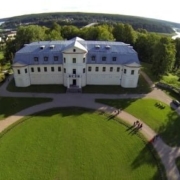
 The Bebrene Estate features an ensemble of Baroque buildings from the late 19th and early 20th century. The dominant building is the mansion of Count Plater-Sieberg, which was built in 1896 after a design by the architect L. J. L. Marconi. It is home to the Bebrene High School today. Surviving to the present day are the ornate gate and the unusual stone fence of the estate. The regular-design park which surrounds the mansion features a wealth of foreign trees.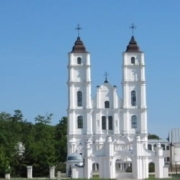
 Basilica in Aglona. In the east of Latvia, in the Preili region, the small town of Aglona is located. It is located in a very beautiful area, between two picturesque lakes. There are many legends associated with this town. So locals believe that it was in this town in the 13th century that the famous Lithuanian King Mindaugas was killed and buried (Lithuanians have a different opinion). This town is populated mainly by Latgale people – very welcoming and open people, having their own respectable culture and traditions.
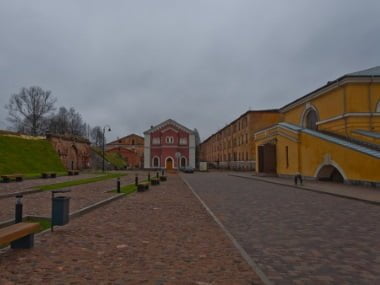 The fortress of Dinaburg in Daugavpils is considered one of the main symbols of the city. It is a pearl and the most significant cultural and historical monument of the second largest city of Daugavpils in Latvia. This is the only fortress of the first half of the 19th century that has survived without significant changes in the Baltics – a vivid evidence of the military history of tsarist Russia. The ensemble of the fortress forms the main fortress (citadel) and a rampart, 8 bastions (pentagonal, extended forward fortifications in the corners of the fortress), ravelins (three angular fortifications in front of the rampart between the bastions), an external protective rampart along which there is a road on the right bank of the Daugava, and some bridge fortifications on the left bank of the river. The territory of the fortress is oval and divided into quarters. In their center is a square front square. Around the square are the quarters of administrative and residential buildings. Facades of buildings are designed in the style of Russian Empire.


 cst
cst
