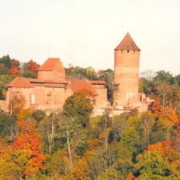


Sights of Latvia are a find for the tourist. Latvia is considered the most beautiful corner of Europe, where nature itself created the conditions for an excellent holiday. It combines beautiful landscapes and pristine beaches, an excellent microclimate, and travelers will appreciate the sights and the most interesting places in Latvia, the hospitality and friendliness of local residents. Going on a journey from the capital of Latvia, Riga, in any direction, you will see all the new sights of Latvia and new aspects of Latvian life.

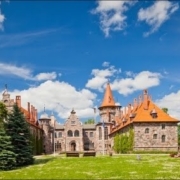
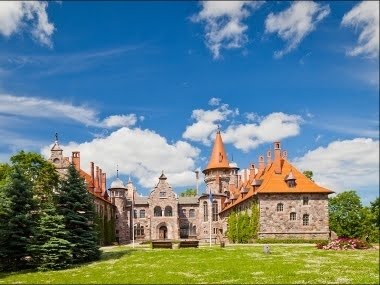
Cesvaine Castle was first mentioned in the 13th century, but it was a wooden Latgal castle on the left bank of the Sula River.
The archbishop’s castle was probably built at the end of the 14th century, as the settlement by the castle is mentioned in the annals in 1410. Cesvaine Castle itself was first mentioned in 1461. In 1479, the castle occupied the order for many years.
The Rusov’s chronicle states that during the Livonian War, in 1577, the castle of Cesvaine was occupied by the Russian troops of Ivan the Terrible. The inhabitants of the castle were captured, but no special damage was inflicted on the structure. The castle was inhabited until the middle of the 17th century. It is likely that Cesvaine castle was destroyed during the Russian-Swedish war. During the construction of the buildings, the ruins of the old castle were almost removed, and in its place the Cesvaine castle was built in the eclectic style, built of granite boulders according to the project of architects G. Grisebach and A. Dinklag. Near the castle, the buildings of the former estate and a romantic park are preserved – there are about 70 species of trees and shrubs.
Cesvaine Castle was built on the right bank of the Sula River. From the north and west it was guarded by a river valley about 50 meters wide and more than 10 meters deep. The river itself is shallow, about 3 meters wide. On the east side was a mill pond. On the south side was a bastion, which was surrounded by a moat, traces of which have survived to this day.
The main castle in the plan was a square. To the south was a bastion of the same square shape. In the southwestern corner of the bastion was a semicircular tower, in which there was an entrance. Later, the entry was moved to the south wall. After the appearance of firearms, in the XVI century, earthen ramparts were poured in the northern corners of the bastion.
Now only the foundation of the western wall is preserved from the old castle, about 50 meters long and about 1 meter high. The width of the base of the wall was 1.5 meters. At the southern end of the wall, the ruins of a 1-2-meter-high southwestern semicircular tower were also preserved.
Tourists, accompanied by a guide, can explore the premises of the castle, and climb the 30-meter observation tower, from which they can see the surroundings within a radius of 20 km.

 Kropotkin Palace.
In the XVII century, a landowner estate began to form on the territory of Sigulda Castle. Several buildings have survived here, erected in the XVIII and XIX centuries during the time of the owners of von der Borchov and Kropotkin – Summer Castle, New Castle, White Castle, Burmistra’s House, manor houses, barn, laundry, cellars for root crops and vegetables.
The new palace (Kropotkin Palace) in Sigulda was built by Princess Olga Kropotkina, nee Countess von der Borch, in 1878 – 1882 on the site of the Order Castle. The Kropotkin Palace was built in the style of the Tudov neo-Gothic style from large, crafted, boulders. The work was supervised by a master mason Janis Mengelis.
Visiting the Kropotkin, who spent the summer months in this palace, many high-ranking guests from the capital visited.
During the First World War, the building was destroyed.
In 1921, the restored Kropotkin Palace passed into the possession of the state. In 1923, the Society of Journalists was housed in the palace. In 1930, the windows of the palace were installed stained glass M. Strunke “Four Seasons”. The building was installed picturesque work of K. Skuin.
In 1936-1937, in the palace – the House of Creativity or the Palace of the Press – perestroika was carried out. According to the project of architect A. Birkans, the height of the tower was increased. The interior authors are well-known Latvian artists of Latvia: Vilis Vasarinsh, Niklavs Strunke, Peteris Ozolins, Karlis Sunins.
During the Second World War, the Kropotkin Palace was used for the needs of the headquarters of the Nord German army. After the war, the USSR Council of Ministers placed a rest house for senior officials in the palace.
In 1953, the palace housed the Sigulda Cardiological and Climatic Sanatorium.
After the restoration of Latvia’s independence in 1991, the Kropotkin Palace was ceded to the state and since 2003 the Sigulda Duma, a restaurant has been located here.
Next to the New Castle is the so-called Yellow House (aka Summer Castle). It was built in the style of classicism at the turn of the 18th-19th centuries. A wooden longitudinal building was erected under the guidance of a master from the city of Cesis, called the last livin of Vidzeme, Marcis Sarums. Here the Kropotkins lived until the completion of the construction of the New Palace. There is also a small church where services were held for the owners of the estate.

 Līgatne – the nature trails of the Gauja National Park were created in 1975 with the aim of acquainting visitors with nature, the species of wild mammals living in Latvia, the diversity of nature and the need for protection.
On the banks of the Gauja River, in a region rich in wooded ravines, trails have been laid for more than 5 km where you can observe animals and birds characteristic of the Latvian fauna. A visit takes an average of 2-2.5 hours.
Wild animals found on nature trails in Ligatne were brought from various places in Latvia. These were injured or tamed cubs of animals that could not survive without human care and constantly find food. Roofs, wild boars, bears, foxes, wolves, moose, lynxes, owls, eagle owls and bison can be observed along the fences of the Ligatne nature trails.
Visiting nature trails in Ligatne, visitors are advised to wear comfortable clothing and shoes suitable for hiking.
Ligatne and its environs contain a significant amount of sandstone outcrops, which we call rocks and rocks. Perhaps there is the largest concentration of sandstone rocks in Latvia, which the inhabitants of Ligatne and its environs have used for many years for domestic and industrial purposes, creating cave and cellar systems.
In Ligatne and its environs there are several tens of rocks and rocks, and the value of all these pearls of nature is no less significant, because how not to mention the Gudu rocks, the Kuku rocks, the Zvarte breed and others.
Very interesting discoveries are associated with caves and cellars located in the rocks. And immediately it is worth recalling that this is not a scourge of the Soviet era, the tradition of using the advantages given by nature in Ligatne has a more ancient history.
Here is what Aivar Balodis, a researcher in the history of Ligatne, writes about this:
“Every self-respecting person thinks that with Ligatne cellars everything is more than clear. Here we are talking about cellars carved in sandstone rocks. Pink, golden and gray sandstone rocks formed 350-370 million years ago. They formed when the currents demolished sand particles and clay rocks that settled, compacted, and cemented to form sandstone and dolomite or sedimentary rocks visible today. ”
Visiting the caves and cellars of Ligatne is available to tourists only with a guide!
On the territory of the Ligatne rehabilitation center at a depth of 9m underground there is a well-equipped bunker with an area of 2000 m2, the stigma of which was removed only in 2003. The bunker was built in the 80s of the last century for the needs of the political and state elite in the event of a nuclear war. Secret shelter of the first secretaries of the Soviet Communist Party, the bunker was one of the strategically important places in Soviet Latvia in the event of a nuclear war. The most powerful autonomous economic structure with all the necessary and latest equipment of the time. Until now, we managed to preserve all the authentic underground equipment!


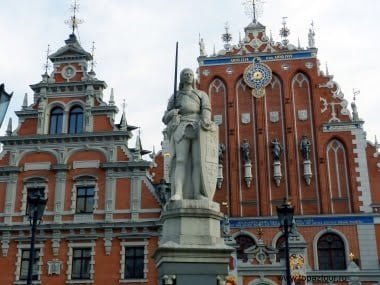 The House of the Blackheads is a famous architectural monument of the 14th century, located in the very center of Riga. Repeatedly reconstructed building was mostly destroyed during the Great Patriotic War. It was possible to restore the building today.
In historical documents, the building was first mentioned in 1334 as the new house of the Great Guild, and was built during the Order Occupation in the period from 1330 to 1353. At the end of the fifteenth century, the building was leased by the Blackheads and was called in those days only “The Court of King Arthur”, the current name of the house was supposedly received in the late 60s and 16th centuries.
Blackheads are a fraternity of young and unmarried foreign merchants. The brotherhood has existed since the end of the thirteenth century and is under the auspices of St. St. George, but later the patron saint of the brotherhood becomes St. Mauritius, whose symbol in the form of a black head in the coat of arms has become the hallmark of the fraternity.
The founders of the richest and most influential company were representatives of not only Riga, but also foreign companies engaged in direct delivery of goods to Riga. They also created the company of the Blackheads as a counterweight to the Big Guild of sedentary merchants in the city engaged in the repurchase of goods. But, despite the separation, the company was still under the supervision of the Big Guild until the end of the seventeenth century.
According to historical data, since 1477, Blackheads have been renting a house built for public needs by a guild of artisans. Decorating and rebuilding the building, the Blackheads over time become the sole owners of the New House. In the first half of the day the building works as a stock exchange, and in the second half of the day it is devoted to relaxation – it hosts various evenings, balls, and concerts, especially since the hall has wonderful acoustics.
At different times in this house there were clearly and secretly Russian tsars and queens. Portraits of the monarchs of Sweden and Russia served as a decoration of the hall, among them there is a portrait personally presented by Catherine the Second. So in the book of guests of honor, among the many entries there is a signature of Bismarck himself.
Along with the Great Guild, the organization led the public life of the city, took an active part in defense, and by the end of 1895 became a club of German merchants, ceasing its activities as a corporation. And since 1939, after the repatriation of the Germans, the club has been closed.
The initial appearance of the house, unfortunately, is unknown. The building covers an area of 425 sq.m., the main part of the house of the Blackheads is occupied by the central hall. Under the hall was a small floor divided into several rooms and a basement under it. The attic of the house served as a storage room. Despite the repeated changes and changes of the whole house – it was the hall that remained untouched, as the core of the building, which is of historical value.
Today’s view of the facade was made in the early 17th century in the style of European mannerism. According to the assumptions of Professor Wipper, the authors of the architecture of the building should be sought among the masters of Bremen, Danzig and Denmark. Nowadays, scientists suggest that this is Bodeker or Jansen. The facade is decorated with sculptures, decoration is made using art forging, another decoration is a watch. The House of Blackheads has a unique astronomical clock with a “perpetual calendar” mechanism. The three dials of the watch, in addition to time, show the date, month and year, as well as the time of sunrise and sunset and moon phase. In the museums of the history of Riga and navigation, as well as in the Architectural Museum, various fragments of the building’s decoration and parts of the interior of the Blackheads house are stored.
In 1684, a porch was completed, through which you can directly go to the second floor from the square. Another extension on two floors was built in 1794, and in 1816 another one, but from the side of the Daugava River. In the same years, the open porch replaced the covered entrance. The most recent and, perhaps, a significant change in the facade was made by the statues of Neptune, Mercury, Unity and Peace, made of zinc and installed in 1886.
In 1941, in June, the house was shelled by German troops, its ruins stood until 1948. Instead of the Town Hall Square, the area of the Latvian Red Riflemen appeared with the museum and a monument to the Latvian Red Arrows instead of the Town Hall Square. After Latvia gained independence, the square was again called the Town Hall, and the museum was renamed the “Museum of the Occupation of Latvia”.
Initially, they did not intend to restore the House of the Blackheads, but by the 800th anniversary of Riga, it was still rebuilt. Before him stands a statue – a symbol of freedom, the judiciary and the protection of trade, in the form of Roland. In the house itself today is a museum and a concert hall, where concerts of symphonic music are often held.
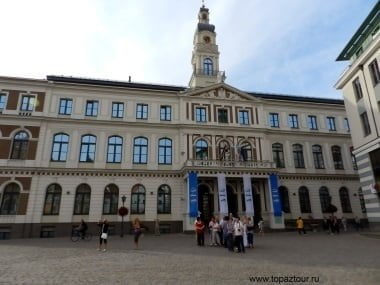 City Hall in Riga is one of the attractions of Riga. Looking at the Riga Town Hall, one gets the feeling that she always stood in this place, but this is not so. The first building of the Town Hall took its place where the laboratory buildings of the RTU now rise. They were erected in the 60s of the 20th century. When in the 1990s they started talking about rebuilding the Town Hall, it was necessary to erect in a new, not in its historical place.
According to historical chronicles, the first building of the City Hall was located at the crossroads of two streets: Tirgonyu (Torgovoy) and Shkunyu (Sarajnoy). The townspeople were able to forcefully gain the right to have a city government after 1225. In those years, those who were dissatisfied with the authority of Bishop Albert von Buxgevden revolted. A year later, in 1226, Riga managed to defend the rights of the city and the opportunity to pursue an independent policy. This circumstance entailed the creation of the city council, as well as the construction of a building for him. The constructed City Hall was located at the so-called large gates, which were the central entrance to Riga.
It is believed that the first building of the Town Hall was destroyed as a result of the battle unleashed by the Order, when Order troops lost Riga as a result of a popular uprising in 1297. Although in 1330 the Order was able to conquer Riga. The new building, which is mentioned in written sources in 1334, was built to replace the old one on the Riga market square.
It is assumed that the second building of the Riga City Hall was built in the Gothic style, the roof was high gable. There were 6 rooms in total. The rooms on the ground floor were rented out as retail space. Every year, on the eve of the national holiday – St. Michael’s Day, when mass festivities took place, the herald from the balcony of the Town Hall read new decrees and decrees, including changes in the field of tax fees, as well as monopolies for the production of any goods (for example, beer). Speeches of heralds later received the name of burgher speeches. After 175, a musician was invited to the Town Hall balcony, who “voiced” the onset of each new hour with a melody.
The second building of the Town Hall suffered severe damage during the siege of the city by the troops of Peter I in 1709-1710. The decision to demolish the building was made only in the middle of the 18th century. At the same time, the design and construction of a new building, the third in a row, began, its construction lasted 15 years due to the fact that the government allocated funds for the construction of the new Town Hall periodically.
The third building of the Town Hall was built in the style of early classicism, the tower had baroque forms, the building itself was framed by a columned portico of the Tuscan order. In 1791, the attic was built.
The reconstruction of the City Hall building began in 1848, the young architect I.D. Felsko supervised the work. Felsko worked on improving the existing building for 2 years, the third floor was built on.
In 1877, as a result of city government reforms, the Riga Council (City Council) was abolished. The main city library of Riga is located in the Town Hall building. In addition to her, there was a bank and an orphan city court. That was until the Second World War. In the summer of 1941, the Former Town Hall building came under crushing fire, at the same time there was a big fire in which many buildings, including the Town Hall, were burned down.
The ruins of the City Hall did not touch for several years. Only after 1954, according to the decision of the Riga City Executive Committee, were they dismantled. And in the middle of the 50s of the 20th century, new buildings of the University of Riga began to be built on the site of the Town Hall. Some fragments of the Town Hall were miraculously preserved to this day: sculptural fragments of the pediment, sculpture of Themis.
Designing a new building City Hall began in the late 1990s. It was possible to implement the project only by the year 2000. The new town hall building was opened in November 2003. The new building is a copy of the historic building, which, however, is evaluated differently by architects and designers. Today, the Riga City Council is located in this building.


 cst
cst
